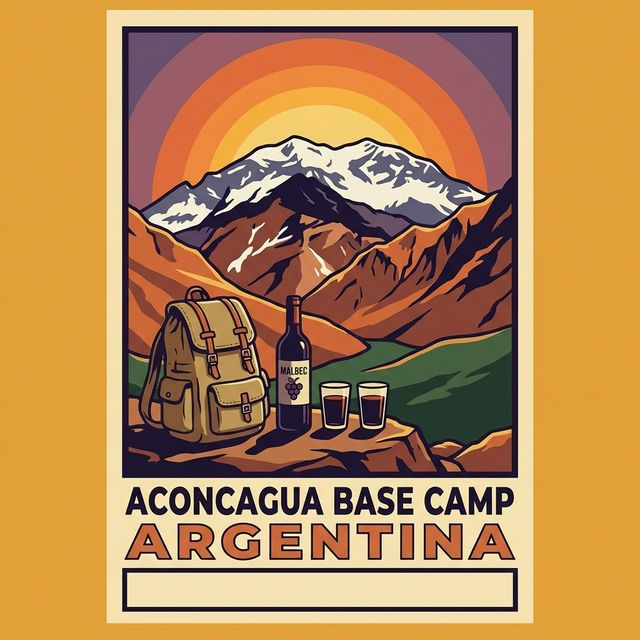
Aconcagua base camp wine toast
The ultimate Andes wine adventure: bring a bottle of Malbec to Confluencia base camp at 3,400m, beneath the highest peak in the Americas. The thin air intensifies both the wine experience and the sense of achievement. Non-technical trekking permits required.
A Wine Memories experience · winememories.fi
Good to know
- Difficulty
- Challenging
- Languages
- Mixed
How to Complete
6 steps curated by Wine Memories
-
Puente del Inca is a natural arch 48 meters long, stained vivid ochre and orange by the iron-heavy thermal springs that built it. Charles Darwin sketched it in 1835. Behind it: the ruins of a 1920s luxury spa hotel that welthy Argentines reached by train until avalanches destroyed it in 1965. Only the colonial chapel survived.
🍷 Log Memory📍 WHERE: Puente del Inca village, 183km northwest of Mendoza on Ruta Nacional 7. GPS: -32.8261, -69.9113. The natural arch is visible from the road — park anywhere in the small village lot.
💡 WHAT: You're looking at a geological accident — glacial melt from the last ice age carved this arch while thermal springs loaded with iron, sulfur, and calcium painted it orange. Darwin stood exactly here in 1835 and made drawings of the stalactites hanging from its underside. Behind the arch, the ruins of a grand 1920s hotel are slowly dissolving back into the hillside — it was destroyed not by time but by avalanches in 1965, which spared only the chapel. Walk down to see the chapel ruins and the abandoned railway station, which a group of Rosario mountaineers converted into the Museo del Andinista — Argentina's only mountaineering history museum.
🎯 HOW: Free, no permit required. Visit any time of day; the open-air ruins are accessible year-round. The Museo del Andinista is staffed seasonally (November–March) by volunteer climbers. If it's closed, the railway station exterior alone is worth the stop. Note: walking on the natural bridge itself is prohibited due to structural deterioration — but standing beneath it and reading the mineral history in the rock face is the real experience.
🔄 BACKUP: If the museum is closed, photograph the ruins from the riverbank below — the reflection of the ochre arch in the Las Cuevas River is the shot.
-
The Aconcagua Provincial Park requires a trekking permit purchased before arrival — you cannot pay at the gate. The process is a commitment ritual: reserve online, pay at a Pago Fácil outlet in Mendoza, present at the Visitor Center. Foreigners pay USD 270 for a 3-day short trek permit, or USD 190 if you hire an authorized guide service.
🍷 Log Memory📍 WHERE: Permit obtained BEFORE the trek, in Mendoza city. Visitor Center address: Av. San Martín 1143, Mendoza, 1st Floor (Mon–Fri 8:00–18:00, Sat–Sun & holidays 09:00–13:00). Official permit website: www.aconcagua.mendoza.gov.ar
💡 WHAT: You need a short trekking permit (Trekking Corto — valid 3 days). This is the permit for the Horcones Valley route to Confluencia base camp. Cost for foreigners: USD 270 independent, USD 190 if you hire a licensed guide/service. Season: November 15 – April 30 only (the park closes in winter). Alternative: book through Inka Expediciones or Andes Vertical who bundle permit + transport from Mendoza into a full-day guided trek (~USD 140–$190 total).
🎯 HOW: Step 1 — Register on aconcagua.mendoza.gov.ar and download your Expedition Form + Payment Ticket. Step 2 — Pay at any Pago Fácil office in Mendoza (ubiquitous, like a post office). Step 3 — Present paid ticket + passport + expedition form at the Visitor Center. Arrive early if visiting in December–January (peak season queues). Email: aconcagua@mendoza.gov.ar for questions.
🔄 BACKUP: If DIY feels complicated, book through a local operator (Inka Expediciones, Andes Vertical, or gotomdz.com) — they handle all permits and include round-trip transport from Mendoza. Full-day guided trek prices run USD 140–270 per person depending on group size.
-
The wine you carry up Aconcagua should be grown from vines that exist only because this mountain exists. The Andes forces the temperature swings that give Malbec its violet intensity and the UV amplification that builds its thick, color-saturated skins. Every great bottle of Mendoza Malbec is, in a literal sense, a thank-you letter to Aconcagua.
🍷 Log Memory📍 WHERE: Buy in Mendoza city before departing — wine shops along Arístides Villanueva Ave (the main wine-bar strip) or at any Carrefour/supermarket for value options. The Mendoza Central Wine Market (Mercado Central on Av. Las Heras) stocks 300+ local producers.
💡 WHAT: The ideal bottle for this trek: Terrazas de los Andes Reserva Malbec (~USD 18–25 at local shops) — specifically designed around altitude philosophy, with vineyards at 980–1,250m on Andean foothills. If you want the maximum symbolic circularity, ask for Catena Zapata's entry-level Malbec (~USD 15): their Adrianna Vineyard at 1,450m in Gualtallary is called 'the Grand Cru of South America' and was planted in 1992 by Nicolás Catena with his youngest daughter Adrianna riding in his backpack on inspection visits.
🎯 HOW: Pack the bottle wrapped in a fleece or jacket in your daypack for insulation and protection. Bring two plastic cups (no glass in the park). Chill is built in — at 3,400m in January, ambient temperature is typically 5–15°C. Carry-in alcohol is permitted for personal use on day treks.
🔄 BACKUP: If you forget to buy in Mendoza, Uspallata village (the last town before the park, 1,800m) has a small almacén (general store) with basic wines. Not ideal, but workable.
-
The approach to Confluencia starts as a wide dirt road through a moonscape of grey-brown scree, but within 30 minutes the south face of Aconcagua emerges ahead — 2,600 vertical meters of rock wall from where you stand to the summit. The mountain doesn't reveal itself all at once. It builds. By the time you reach Confluencia, the south face fills your entire field of vision.
🍷 Log Memory📍 WHERE: Horcones Trailhead, Aconcagua Provincial Park. GPS of trailhead parking area: -32.8242, -69.9427. Drive or take minibus from Puente del Inca village (2km, 5-min walk or hitch). Park at the lot and check in at the Alfredo Magnani Visitor Center.
💡 WHAT: The trail to Confluencia is 7.1km one way, 600m elevation gain, taking 3–4 hours at trekking pace. The terrain is open valley — no technical sections, no scrambling. The Horcones River runs alongside much of the trail. At Confluencia (3,390m), you'll see the cluster of bright yellow expedition tents, the ranger station, and the medical post. The rivers Lower and Upper Horcones meet exactly here, hence the name. Above you: the south face of Aconcagua, one of the most technically demanding walls in mountaineering, still bearing a glacier on its upper face.
🎯 HOW: Start early — 7:00–8:00am from Puente del Inca to avoid afternoon wind. Take the narrow single-track trails where available (they run parallel to the 4x4 road and are more scenic). Check in at the medical station on arrival — it's mandatory. Rangers check oxygen saturation and vital signs. Drink 3L of water during the hike (altitude dehydrates faster than you expect). Return trip takes 2 hours.
🔄 BACKUP: If altitude symptoms become serious (vomiting, disorientation, severe headache), turn back immediately — Confluencia's medical staff can assess and assist. Mild headache is normal above 3,000m; drink water and pace yourself.
-
At 3,390 meters, you are at the elevation where most of the world's serious mountaineers first feel the altitude. The Incas chose this mountain for their holiest sacrifices. In 1985, archaeologists recovered a 7-year-old boy from 5,300 meters — perfectly preserved after 500 years, wrapped in textiles, surrounded by statuettes, killed as an offering to the gods that lived here. Now you pour a glass of Malbec from vines that grow because this mountain sculpts the temperature and light. The circularity is almost too neat.
🍷 Log Memory📍 WHERE: The riverbank just below Confluencia camp (GPS: -32.7806, -70.0367), where the two Horcones rivers merge. This is the most dramatic viewpoint — the south face of Aconcagua rises directly in front of you, and you can see the mountain's glacier catching the afternoon light.
💡 WHAT: Open the bottle you carried up. Pour two glasses. Before drinking, look up: the mountain has an 8–10 million year geological biography, a 500-year Inca ritual history, and a 130-year mountaineering story. The wine in your glass exists because glaciers from that mountain built the soil below and because the Andes elevation creates the exact UV intensity, cold nights, and drainage that Malbec needs to develop the thick skins and intense color that define the variety. You are literally drinking the mountain.
🎯 HOW: Afternoon (14:00–16:00) gives the best light on the south face. At 3,390m, the wine will taste slightly different — scientific tastings confirm wine at altitude registers as smoother and more harmonious, with less carbonic edge. You may feel light-headed faster than expected — not from alcohol but from the combination of exertion, thin air, and dehydration. Drink water alongside. One glass is plenty. Eat before opening.
🔄 BACKUP: If weather closes in (afternoon thunderstorms are possible December–January), taste at the ranger station picnic area instead — still at altitude, still dramatic, with the tent camp as foreground.
-
The descent back to Horcones takes 2 hours. By the time you reach Puente del Inca, you will have climbed to 3,390m and back in a single day. The correct ending is dinner at Mendoza. Francis Mallmann's 1884 restaurant is Argentina's most famous chef at his most theatrical — seven-fire asado techniques, open flames in a nineteenth-century bodega, and a wine list that includes three different altitude expressions of the same Malbec grape so you can taste the mountain in the glass.
🍷 Log Memory📍 WHERE: Restaurante 1884, Francis Mallmann. Address: Belgrano 1188, Godoy Cruz, Mendoza (inside Bodega Escorihuela Gascón). GPS: -32.9289, -68.8502. Tel: +54 261 424 2698. Reservations essential (book 1–2 weeks ahead in peak season via 1884restaurante.com.ar)
💡 WHAT: Francis Mallmann literally wrote the book on seven-fire cooking (Seven Fires: Grilling the Argentine Way). His 1884 restaurant operates inside a 19th-century bodega. Order the asado — beef slow-cooked over open coals the way gauchos have done it since before Argentina was a country. Then ask the sommelier to pour you three altitude expressions: a 800m valley Malbec (broad, plush), a 1,200m Luján de Cuyo Malbec (structured, darker), and anything from Catena's Adrianna Vineyard at 1,450m (precise, electric). You've spent the day at 3,390m. Now descend through the altitude spectrum in the glass.
🎯 HOW: Reservations required at dinner. Lunch is walk-in friendly. Main courses run USD 30–60 per person; full wine-paired tasting menu USD 100–140. Dress smart-casual (trekking gear is fine if clean).
🔄 BACKUP: For a more rustic version of the same idea, Francis Mallmann's Siete Fuegos restaurant at the Vines of Mendoza resort in Valle de Uco is an hour south of Mendoza city and set directly against the Andes foothills — visually more dramatic, closer to the mountain you just descended.
Insider Tips
- ✦
Confluencia camp (3,400m) is the non-technical limit - no climbing required
- ✦
Wine tastes different at altitude - the experience is worth the effort
- ✦
December-March offers best weather and permit availability
Fact-checked March 2026 · 20 sources
View sources
- shortgirlontour.com
- musafirintransit.com
- earthtrekkers.com
- en.wikipedia.org
- en.wikipedia.org
- atlasobscura.com
- andes-vertical.com
- inkaexpediciones.com
- andesinfinito.com
- wordonthegrapevine.co.uk
- tastingtable.com
- winespectator.com
- catenazapata.com
- en.wikipedia.org
- alpenglowexpeditions.com
- aconcaguaadventures.com
- terrazasdelosandes.com
- gotomdz.com
- mendoza.gov.ar
- alltrails.com