Athens: Acropolis & Agora
Wine was central to Greek democracy and philosophy. The Agora where Socrates debated was surrounded by wine merchants. The Acropolis temples received wine offerings. This is where Western wine culture began.
A Wine Memories experience · winememories.fi
How to Complete
4 steps curated by Wine Memories
- 🍷 Log Memory
📍 WHERE: Hadrian's Arch, Leoforos Vasilissis Amalias, Athens — the great triumphal arch standing free on the main boulevard, Temple of Olympian Zeus visible directly behind it. GPS: 37.9703, 23.7320. No gate, no ticket, accessible at any hour.
💡 WHAT: This arch contains the most honest confession in Roman history, carved in stone in 131 AD. Walk to the northwest face — the side facing the Acropolis — and read: 'This is Athens, the ancient city of Theseus.' Now walk to the southeast face — the side facing the Temple of Olympian Zeus — and read: 'This is the city of Hadrian, and not of Theseus.' Two sentences. The entire relationship between Rome and Greece, in marble. Rome conquered Greece militarily in 146 BC. But every educated Roman grew up speaking Greek, reading Greek philosophers, dreaming of Athens. Cicero studied here in 79 BC with the philosopher Antiochus of Ascalon. Hadrian — emperor of the largest empire in history, nicknamed 'the little Greek' by Romans who found his devotion embarrassing — grew a beard specifically to look more Greek. He didn't conquer Athens. He completed it. That temple behind the arch? Construction started 515 BC, stalled for 638 years through political chaos and wars, until Hadrian personally finished it in 131 AD and dedicated it as 'Panhellenios' — Zeus of all Greeks. An emperor finishing a 638-year project. The arch marks it all.
🎯 HOW: Come early — this is free and open 24 hours, but the light on the marble and the empty boulevard at 7–8 AM is revelatory. Stand between the two inscriptions. Turn to face each side in sequence. The Temple of Olympian Zeus is directly behind you when you face the 'city of Hadrian' side — walk through the arch and you enter the Olympieion precinct (€8 entry) to see the 15 surviving columns and the one that fell in an 1852 storm and has never been moved.
🔄 BACKUP: If arriving later in the day, the arch is equally moving at golden hour when the marble goes amber. The inscriptions are on both faces at upper-attic level — bring the translated text on your phone if the light is low.
- 🍷 Log Memory
📍 WHERE: Tower of the Winds, inside the Roman Agora of Athens, Pelopida 24, Monastiraki. Entry: €8 summer (April–October), €4 winter. GPS: 37.9742, 23.7269. Five-minute walk from Hadrian's Arch through the Plaka neighborhood.
💡 WHAT: The Tower of the Winds (built c. 1st century BC by Andronikos of Kyrrhestes) is the world's first weather station: an octagonal marble tower that was simultaneously a sundial with eight carved faces, a water clock fed by a channel from the Acropolis, and a weather vane — a bronze Triton on the roof that rotated to point at one of eight carved wind gods around the tower's crown. Each face is carved with the god of its wind: Boreas (north), Kaikias (northeast), Apeliotes (east), Euros (southeast), Notos (south), Lips (southwest), Zephyros (west), Skiron (northwest). Walk the perimeter and find each one. The tower is practically intact after 2,000 years. Immediately around it: the Roman Agora, funded directly by Julius Caesar and Augustus (built 19 BC–11 AD) — a new covered marketplace the Romans built east of the ancient Greek one, because the Greek Agora was too sacred, too crowded, too historic to rebuild. So they built their own. Hadrian's Library, another Hadrianic monument of extraordinary scale, is a two-minute walk north (Areos 3, Monastiraki; €6 entry) — its western propylon wall still stands at full height, four massive columns intact.
🎯 HOW: Buy the Roman Agora ticket at the entrance. Walk the perimeter of the Tower of the Winds first, identifying all eight wind gods by their carved attributes (Boreas wears a cloak, Zephyros scatters flowers). Then explore the Roman Agora ruins around it. Budget 45–60 minutes. The old Ministry of Culture combo ticket (€30 covering 7 sites) was discontinued April 2025 — each site now sells separately.
🔄 BACKUP: If the Roman Agora is temporarily closed for conservation work (rare but possible), Hadrian's Library next door (Areos 3, Monastiraki, €6) gives the same Roman-era monumental architecture — the intact propylon wall is genuinely stunning. Both sites are in the same Monastiraki neighborhood.
- 🍷 Log Memory
📍 WHERE: Acropolis south slope, Athens. Access via Dionyssiou Areopagitou pedestrian street (the grand boulevard running below the Acropolis). Acropolis ticket: €30 adult (April–October), €20 (November–March). GPS of the main gate: 37.9714, 23.7262. The south slope is accessed through the main Acropolis ticket — entry from the west (Beule Gate) includes the slopes.
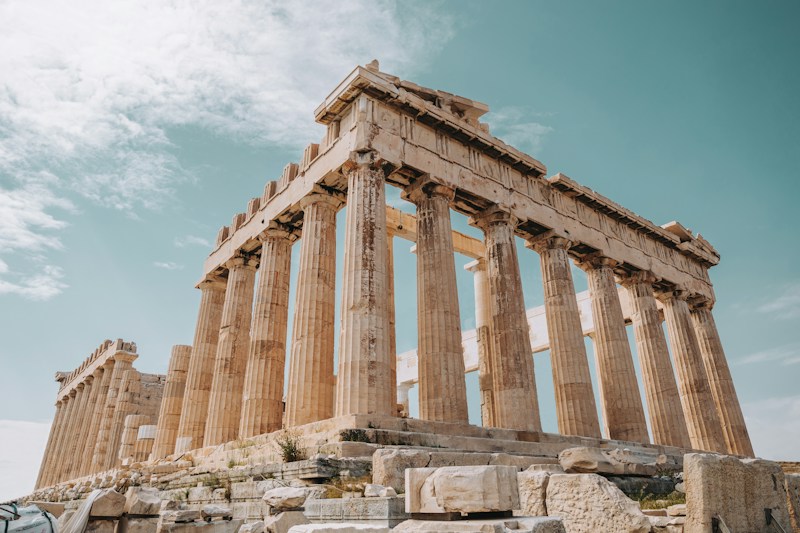
💡 WHAT: Begin at the Odeon of Herodes Atticus (southwest slope, GPS 37.9708, 23.7244). Herodes Atticus (AD 101–177) was the richest man in Athens — born Athenian, became a Roman senator and suffect consul, tutor to Emperors Marcus Aurelius and Lucius Verus. He built this theatre in 161 AD as a memorial to his wife Appia Annia Regilla, who died under circumstances that brought him to trial for her murder. Marcus Aurelius acquitted him personally. The theatre — 5,000 seats, cedar roof now gone but the stone seating and stage wall still stand — hosts the Athens Epidaurus Festival from June through early October: opera, concerts, ancient drama. If you're here during festival season (June–early October), evening performances begin around 9 PM; check aefestival.gr. Tickets range €25–€110. Then walk east along the slope to the Theatre of Dionysus — this is where tragedy was literally invented. Aeschylus, Sophocles, Euripides premiered their works on this stage. A wine libation to Dionysus opened every performance. Continue up to the Acropolis itself: the Parthenon, the Erechtheion, the Propylaea. The Romans never dismantled any of it. They preserved the Acropolis as sacred ground — a deliberate act of reverence that has no parallel in their imperial history. Athens and Sparta remained 'free cities' under Roman rule, partly autonomous, exempt from the full weight of Roman taxation.
🎯 HOW: Allow a full morning — 3–4 hours for the slopes and summit. Arrive at 8 AM when the gates open; the Parthenon is clear of crowds before 10 AM. In summer, the Acropolis closes 1–5 PM on days when temperature exceeds 40°C. Bring water. During the Athens Festival, book Odeon tickets at aefestival.gr at least 2 weeks ahead — sold out weeks in advance for major productions.
🔄 BACKUP: If summer heat protocols have closed the Acropolis hilltop, the south slope (Odeon and Theatre of Dionysus) remains separately accessible. The view of the monuments from Dionyssiou Areopagitou boulevard below is itself extraordinary — and free.
- 🍷 Log Memory
📍 WHERE: Heteroclito wine bar, 2 Fokionos & Petraki, Athens 10563 (corner of Fokionos and Petraki Streets, a 5-minute walk from Syntagma Square toward Monastiraki). GPS: 37.9756, 23.7306. Hours: Mon–Thu 12:30–midnight; Fri–Sat 12:30–01:30; Sun 18:00–midnight. Phone: +30 210 323 9406.
💡 WHAT: Heteroclito opened in 2012 specifically to showcase Greek native varieties — over 200 Greek wine labels, heavy emphasis on natural wines. It is credited with helping start the Athenian natural wine renaissance. Ask the staff for two pours side by side: first, a Savatiano from Domaine Papagiannakos (Mesogaia, Attica; their old vine bottling uses 50–60 year old vines, 30km from the shadow of the Acropolis — the estate was founded in 1919). This is the grape Pliny the Elder documented. In his Naturalis Historia he described the practice of adding Aleppo pine resin to wine from this region and recommended Aleppo pine specifically for its aromatics. Savatiano WAS the retsina grape — bulk-produced, dismissed for decades — until Vassilis Papagiannakos proved it could make structured, age-worthy dry white wine. The old vine version shows stone fruit, honey texture, and a mineral thread that tastes exactly like what it is: an ancient grape from chalky Attic soil. Second pour: a glass of Retsina from Papagiannakos or Markou Vineyards — made the old way, with actual Aleppo pine resin, to taste what Pliny was describing. The resin character is subtle in modern premium Retsina; not the harsh antiseptic of cheap bottles. Ask the staff to talk you through the Attica producers on their list — they know these wines well.
🎯 HOW: Walk in without a reservation during the week; weekends are busier after 8 PM. A glass of Savatiano runs approximately €6–9; Retsina similar. The bar stocks an extensive selection of small-producer Attica wines alongside Assyrtiko from Santorini, Xinomavro from Naoussa, Agiorgitiko from Nemea — if you want to extend into the broader Greek wine revival, tell the staff how much time you have.
🔄 BACKUP: If Heteroclito is unexpectedly closed, Oinoscent (Xenofontos 3, Syntagma area) and By the Glass (Souri 3, Monastiraki) both carry strong selections of Attica wines. Any of the three will have Papagiannakos Savatiano.