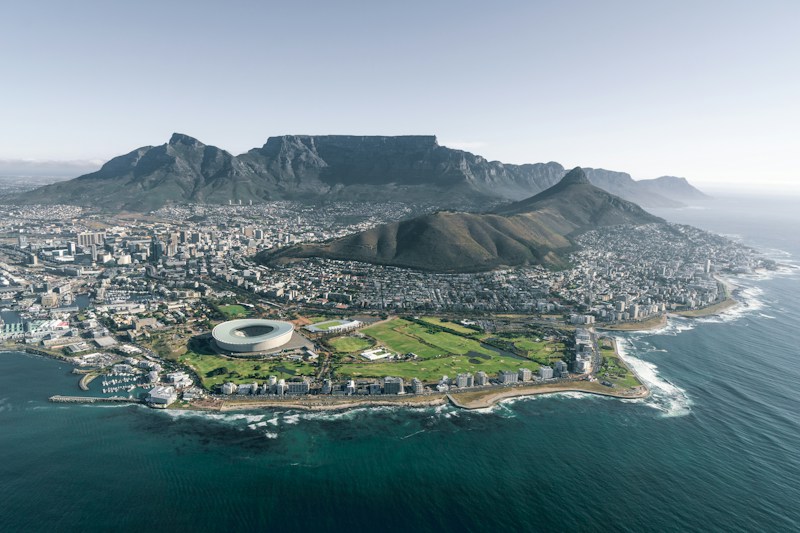
Cape Town: Table Mountain Champagne Cruise
Tigger 2 sunset champagne cruise with braai (BBQ) available ON the boat. See Table Mountain, Lion's Head, and Signal Hill from the water. Cape Grace's Heirloom Restaurant offers Table Mountain views with 'champagne flows, oysters on ice.' Africa's champagne moment.
How to Complete
5 steps to experience this fully
-
360-degree views as you ascend 1,085m to the top of Table Mountain
🍷 Log MemoryThe cable car floor rotates 360 degrees during the 5-minute ascent. Everyone gets views. You're rising 1,085 metres above sea level to stand on 540-million-year-old Table Mountain Sandstone. The same rock that defines the soil of Constantia, Stellenbosch, and the entire Cape Floral Kingdom. This mountain and the geology beneath it are WHY South African wine exists. The Benguela and Agulhas currents meet at Cape Point below. The fynbos covering every slope is unique to this mountain range. You're standing on the foundation of 370 years of wine history. Table Mountain Aerial Cableway, Tafelberg Road. From the city, take Kloof Nek Road toward the mountain. Park in the lower or upper cable station parking lots. Book in advance at https://www.tablemountain.net/ or https://www.webtickets.co.za. Adult ticket: R395 (2026 price), but locals get R250 in February with SA ID. Seniors (60+): R130, Students: R300 with valid ID. Select sunset time slot - cable car operates until 20:00 in summer (Dec-Feb), 18:00 in winter. Book 1-2 weeks ahead during peak season (Dec-Jan, Sept-Oct during whale season) - same-day tickets sell out by mid-morning. Cable car is weather-dependent - high winds close it. Dress in layers - it's 5-10°C colder on top. If the cable car is closed due to weather, drive to Signal Hill or Lion's Head for sunset views over the city and Atlantic Ocean. Or hike Platteklip Gorge (2 hours up, moderate-hard) if you're fit - but you won't make sunset unless you start at 15:00.
-
Look south to Cape Point - the climate engine of Cape wine
🍷 Log MemoryLook south. That distant point of land is Cape Point, where the cold Atlantic Benguela Current meets the warm Indian Ocean Agulhas Current. This collision of ocean temperatures creates the ENTIRE climate system that makes Cape wine possible. The Benguela brings Antarctic cold - the same water the Southern Right Whales swim through to reach Hermanus. The cool air funnels into Constantia, Hemel-en-Aarde, and Elgin. The maritime breezes moderate Stellenbosch and Franschhoek. Without this meeting of currents, the Cape would be a desert unsuitable for viticulture. You just spent 7 days tasting the RESULT of what you're looking at: cold water, fynbos-covered mountains, and 540-million-year-old sandstone. From the cable car upper station, walk south toward the edge overlooking False Bay and Cape Point. There are marked viewpoints and benches. Bring binoculars if you have them. On clear days, you can see all the way to Cape Point (45km away). Ask any guide or staff on the summit: 'Where do the two oceans meet?' They'll point south. Then ask: 'Why does Cape wine taste different from Australian or Californian wine?' The answer is standing right in front of you: COLD ocean. California has the Pacific, but it's warmer. Australia has no Antarctic current. South Africa sits between two oceans, and the cold one wins. If visibility is poor due to clouds or wind, walk to the western edge overlooking Camps Bay and the Twelve Apostles mountain range. You'll see the Atlantic stretching to the horizon - the same ocean the first VOC ships crossed to bring vine cuttings in 1655.
-
Walk among the Cape Floral Kingdom - one of only 6 floral kingdoms on Earth
🍷 Log MemoryYou're standing in the Cape Floral Kingdom, one of only SIX floral kingdoms on Earth. The others are entire continents. In an area smaller than Portugal, there are 9,600+ plant species. 70% found NOWHERE else on the planet. This fynbos - proteas, ericas, restios - grows wild in the vineyard margins of Constantia and Stellenbosch. The plant roots penetrate deep into nutrient-poor, acidic sandstone soils. Winemakers talk about 'fynbos minerality' and 'herbal notes' in Sauvignon Blanc and Chenin Blanc. THIS is what they mean. The ecosystem you're walking through is the terroir ingredient that makes Cape wine taste like no other wine on Earth. Anywhere on the summit paths. The plateau is crisscrossed with boardwalks and trails. Stay on marked paths - the fynbos is protected. Kneel down (gently) and touch the fynbos leaves. They're tough, leathery, small - adaptations to survive fire, wind, and poor soils. Smell them - many have essential oils. Now think back to the Sauvignon Blanc you tasted at Constantia or the Chenin Blanc from Stellenbosch. That herbaceous, slightly wild, mineral character? It's this. The vines grow in the same soils as these plants. Ask any botanist or guide on the summit: 'Why is fynbos only found here?' Answer: Ancient Gondwana soils, Mediterranean climate with wet winters, and FIRE - fynbos needs fire to regenerate. If it's too windy or cold to walk the paths, look for the fynbos from the cable car station viewing platform. The King Protea (South Africa's national flower) is easy to spot - large pink flowers on thick stems.
-
The Flying Dutchman legend and the VOC ships - the same origin story
🍷 Log MemoryThe Flying Dutchman legend originates from these waters. VOC captain Barend Fokke sailed the route around the Cape of Good Hope in 1677-1678, completing the Netherlands-to-Batavia journey in just over 3 months when it usually took 8-12 months. Rumors spread that he'd made a deal with the devil. The ghost ship illusion is REAL. Temperature inversions where the cold Benguela Current meets warm air 'lift' ships into the sky, making them appear to float above the water. The VOC ships that brought the first vine cuttings to Jan van Riebeeck in 1655 sailed through these exact waters. The same ships that started South African wine also started the ghost ship myth. They're the SAME origin story. On the summit at sunset, look west toward the open Atlantic Ocean as the sun drops toward the horizon. As the sun sets over the Atlantic, imagine the VOC ships approaching the Cape. Months at sea, scurvy-ridden crews, precious cargo including vine cuttings wrapped in damp cloth. They rounded Cape Point, saw Table Mountain, and knew they'd survived. Those cuttings became Groot Constantia, Klein Constantia, and 370 years of wine history. Watch for the 'green flash' at the exact moment the sun disappears - a split-second burst of green light caused by atmospheric refraction. It's rare but possible from this height. If you see it, you've just witnessed the same optical phenomenon that creates the Flying Dutchman illusion. If sunset isn't visible due to clouds, walk to the eastern edge at sunrise the next morning. Watch the sun rise over False Bay and Stellenbosch. The vineyards you visited are waking up down there, starting another day of photosynthesis that will become wine.
-
From Robben Island to wine renaissance - 30 years of transformation
🍷 Log MemoryFrom this summit, you can see Robben Island. The prison where Nelson Mandela spent 18 of his 27 years in captivity. In 1994, apartheid ended. Within WEEKS, international wine orders flooded in. Sanctions had strangled the industry for decades. By 2003, the percentage of grapes made into bottled wine (instead of bulk brandy) jumped from under 30% to over 70%. The wine renaissance you've been tasting for 7 days - Eben Sadie, Hamilton Russell, Paul Cluver, the Old Vine Project, Black winemakers like Carmen Stevens and Ntsiki Biyela - is only 30 years old. This trail walked you through 370 years of history. The last 30 have been the most explosive. You're witnessing the transformation in real time. Near the upper cable station, there are several plaques and memorials. Look for references to Robben Island and Nelson Mandela. Look northwest toward Robben Island (12km offshore). On clear days, you can see it - a small, flat island. Mandela was released in 1990. The first democratic election was 1994. Tim Atkin MW wrote in 2020: 'In just one generation, Cape wine has taken a giant step forward.' You're standing at the finish line of that journey. Ask yourself: What did I learn about South Africa's wine that I didn't know before? The answer is the gift you take home. If visibility is too poor to see Robben Island, visit the Robben Island Museum exhibit at the V&A Waterfront the next morning before your flight home. It will contextualize everything you've experienced on this trail.