Every walking tour in Helsinki covers the same five things. This one covers those plus a fortress island, a bridge that divides the city by social class, bells composed by Sibelius, and seven glasses of wine.
Standard Helsinki walking tours follow a predictable loop: Market Square, Senate Square, Helsinki Cathedral, Esplanadi Park, maybe Temppeliaukio Rock Church if the guide is feeling ambitious. Two hours. Twenty tourists. One right answer to every question.
Helsinki’s wine trail covers 80% of those same sights — and adds a military fortress island, Helsinki’s bohemian quarter, the Design District, a legally protected Art Nouveau pharmacy, and seven curated wine stops between. You see more of the city. You learn more about it. And you end the day with champagne on the Esplanade instead of a gift shop keychain.
Here is every sight, every secret, and every glass.
Quick Facts:
| Detail | Info |
|---|---|
| Distance | 7.4 km + ferry |
| Major sights | 9 |
| Wine stops | 7 |
| Duration | 10:00–22:00 |
| Budget | EUR 140–180 |
| Free highlights | Sibelius bells, WWII shrapnel |
Why Don’t Helsinki Walking Tours Include the Islands?
Commercial walking tours don’t go to islands. Ferries complicate logistics. This is a mistake.
The JT-Line ferry leaves Market Square at 10:00. Twenty minutes later, you’re on Vallisaari — a 30-hectare island that was sealed from the public for over 200 years. Russian ammunition depot. Finnish military base. Then abandoned to forest, bats, and wildflowers. Civilians were banned until 2016.
The nature trails wind through brick-vaulted powder cellars open to the sky, wildflower meadows, and granite tunnels carved by the Russian navy. Over 400 plant species colonised the island without a single human decision. On a Friday morning, you might have an entire trail to yourself.
Then: a wine tasting on a south-facing terrace. Five wines, food pairings, a sommelier who tells stories instead of reciting tasting notes, and a DJ playing something warm between pours. Ninety minutes. The Baltic Sea in every direction. No walking tour in Helsinki offers anything remotely like this.
Details: IISI tasting 59 EUR (book at iisivallisaari.fi/tapahtumat). Ferry ~10 EUR return. Full island guide: Vallisaari deep dive
What Should You See at Helsinki’s Market Square?
Back on the mainland by early afternoon. Before you walk anywhere, look around.
Havis Amanda (1908) — the bronze mermaid fountain by Ville Vallgren. Every May Day, university students wade into the fountain and crown her with a white cap. It’s Finland’s most chaotic tradition and the most photographed moment of the Helsinki year.
The Tsarina’s Stone (1835) — an obelisk commemorating Empress Alexandra’s 1833 visit. Helsinki’s oldest public monument, erected before Finland existed as a country.
Uspenski Cathedral — visible on the Katajanokka hill to your right. The largest Orthodox church in Western Europe. Thirteen golden onion domes: Christ plus the twelve apostles. Red brick, built in 1868. Five EUR to go inside since May 2025.
The Presidential Palace (1818) — neoclassical, directly facing the harbour. The president doesn’t live here anymore, but the building still radiates the authority of a city that was designed to impress a Tsar.
Photo ops: Uspenski’s gold domes from the harbour, Havis Amanda with the cathedral behind, the market stalls with Suomenlinna’s silhouette across the water.
Why Is Helsinki’s 1889 Market Hall Worth Visiting?
Two minutes from the ferry pier, walking along the Etelaranta waterfront.
Helsinki’s Vanha Kauppahalli has been in continuous operation since 1889 — longer than Finland has been independent. Over 20 vendors under Gustaf Nystrom’s red-brick roof: smoked fish, Karelian pasties, oysters, reindeer jerky, and Finland’s smallest Alko store (the state wine monopoly, tucked inside a 19th-century market).
Stop for something to eat. The smoked salmon at E. Eriksson is worth the walk on its own. Then continue west.
What’s the Story Behind Helsinki’s Senate Square?
One block north via Sofiankatu. This is the postcard.
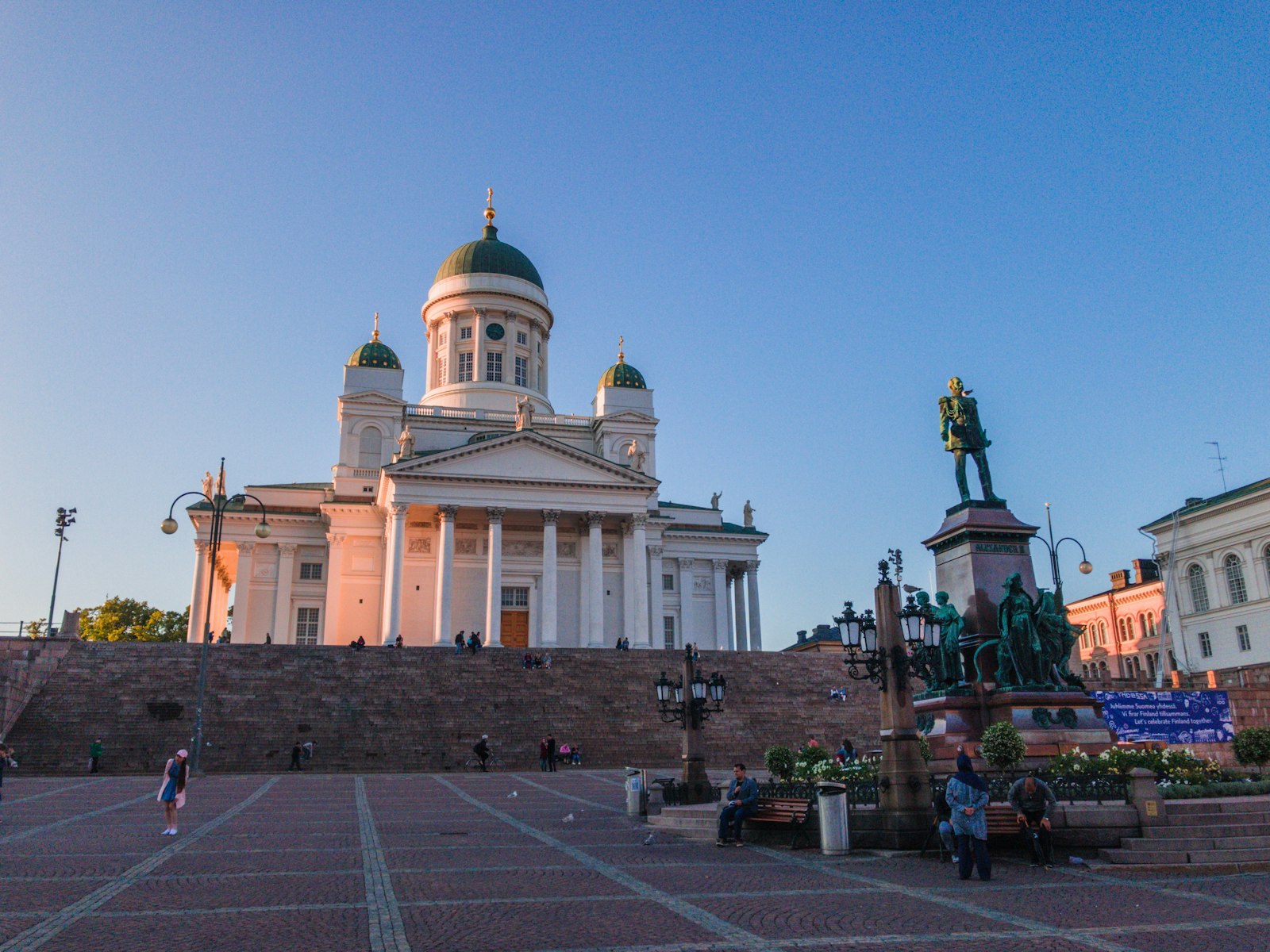
Helsinki Cathedral (1852) — Carl Ludvig Engel’s masterpiece. White neoclassical dome, massive Corinthian columns, a staircase built for drama. Engel was a jobless German architect displaced by Napoleon who ended up designing virtually every important building in a country he’d never planned to visit. Six columns per face. Count them.
Sederholm House (1757) — Helsinki’s oldest surviving stone building, directly on the square. Built by Johan Sederholm, the city’s wealthiest merchant — who made his fortune in alcohol. Helsinki’s drinking culture is literally built into its oldest architecture.
Helsinki City Museum (Aleksanterinkatu 16) — free entry, 325,713 visitors in 2025. The entire story of a city that burned down four times, got invaded twice, and became a wine capital.
Photo op: Helsinki Cathedral from Sofiankatu. The classic postcard angle.
What Hidden History Lines Helsinki’s Bulevardi?
From Senate Square, walk west along Pohjoisesplanadi, through Erottaja junction, and onto Bulevardi. This is the richest leg for sightseeing.
Erottaja Fire Station (1891) — designed by Theodor Hoijer. Neo-Gothic red brick. The most beautiful fire station in Finland. You’ll know it when you see it.
Old Church Park (Vanha kirkkopuisto) — north side of Bulevardi. Helsinki’s Old Church (1826, another Engel building) sits in a park that was a plague cemetery in 1710, when two-thirds of the city’s population died. There’s a memorial plaque on the park gate. Johan Sederholm — the booze merchant from Senate Square — is buried in the northeast corner. Birth to death, Helsinki’s alcohol story is a 500-metre walk.
Sinebrychoff Park — originally the grounds of Helsinki’s first brewery (established 1819). The octagonal red-brick tower on the cliff is the landmark. The Sinebrychoff Art Museum next door houses Paul and Fanny Sinebrychoff’s donated art collection in an 1840s residence.
This walk ends at Stop 3 on the wine trail: Viinibaari Apotek — wine served inside a 1903 Art Nouveau pharmacy with legally protected original cabinets. 12-18 EUR/glass.
Why Is There a Chapel of Silence in Helsinki’s Busiest Square?
Walking north from Apotek toward Dagmar, you pass through Kamppi.
Kamppi Chapel of Silence (2012) — a wooden, nest-shaped ecumenical chapel on Narinkka Square. Won the International Architecture Award. Open to all, regardless of religion. Step inside. Stay 60 seconds in total silence. The busiest shopping area in Helsinki, and in the middle of it, a space where no one speaks. That contrast is the most Helsinki thing imaginable.
Amos Rex — underground contemporary art museum beneath Lasipalatsi square. The dome skylights on the plaza are Instagram-famous. Under-30: 5 EUR. Under-18: free.
The Three Smiths Statue (1932) — Felix Nylund’s bronze at the corner of Aleksanterinkatu and Mannerheimintie. Look at the pedestal. The shrapnel damage is from a 1944 Soviet air raid — WWII scars still visible on bronze, 80 years later.
Why Did Finland Spend EUR 98 Million on a Library?
Still walking north toward Dagmar in Toolo.
Parliament House — fourteen Corinthian columns on a hilltop. Imposing in the way that democratic buildings aren’t supposed to be.
Oodi Central Library (2018) — ALA Architects’ undulating timber building. Free to visit. 3D printers, gaming rooms, music studios, a rooftop terrace with a view of Parliament. Finland spent 98 million euros on a library because the entire culture operates on the assumption that beautiful things should be free.
Detour (5 minutes west): Temppeliaukio Rock Church — a church excavated from solid bedrock. Copper dome, extraordinary acoustics, natural light pouring through the rock walls. 5-6 EUR. One of Helsinki’s most visited sites, and the rare attraction that exceeds the hype.
Stop 4 on the wine trail is around the corner: Dagmar Bistro. “Wine is Fun” tastings from 18 EUR.
What Is the Bridge That Has Divided Helsinki for 375 Years?
This is the most dramatic walk on the trail. From Dagmar, head south to Muru Wine Bar (Stop 5), then northeast through the city centre toward Kallio.
Helsinki Central Railway Station (1919) — Eliel Saarinen’s granite Art Nouveau masterpiece. The pair of stone torch-bearing giant statues flanking the entrance are Helsinki’s most recognizable icons. Saarinen won the competition with this design; his son Eero would later design the TWA terminal at JFK.
Pitkasilta bridge — “Long Bridge,” ironically only 75 metres. A wooden bridge first stood here in 1651. The current stone three-arched version dates to 1912. Damaged in the 1918 Civil War and WWII air raids. This bridge has divided Helsinki for 375 years: polished city centre to the south, working-class Kallio to the north. You will feel the neighbourhood change under your feet as you cross.
Why Is Kallio Called Helsinki’s Brooklyn?
North of the bridge, everything shifts. Kallio was built as a working-class district in the early 1900s. Today it’s Helsinki’s bohemian headquarters: vegan bistros, vintage shops, street art, dive bars next to destination restaurants.
Kallio Church (1912, Lars Sonck) — massive grey granite Jugend landmark visible from everywhere in the neighbourhood. At noon and 6 PM, four bells play a melody composed by Jean Sibelius specifically for this church (JS 102, 1912). If you time your arrival, this is the single best free moment on the entire trail. Stand at the base of the church and listen. Sibelius wrote this.
Karhupuisto (Bear Park) — a small triangular park with a 1931 red granite bear statue. Your landmark for Stop 6: Wino, on the next street (Fleminginkatu 11). Natural wine, candlelight, funk on the soundtrack. Six tables. Book ahead.
Fleminginkatu — the heart of bohemian Kallio. Vintage shops, cafes, street art on every other building. Spot three murals between the bridge and Wino.
How Does Helsinki’s Wine Trail End on the Esplanade?
From Wino, walk south back across Pitkasilta, through the old cobblestone streets of Kruununhaka — one of Helsinki’s oldest districts — and along the Esplanade to the final stop.
Johan Ludvig Runeberg statue (1885) — Finland’s national poet, who wrote the national anthem. February 5 is Runeberg Day; bakeries sell Runeberg torte. This was the first public monument erected in Helsinki.
Kappeli (1867) — the glass-and-steel restaurant pavilion where Sibelius, Gallen-Kallela, and Eino Leino drank together in the 1890s. Still operating. Walls decorated with Albert Edelfelt paintings. Don’t go in — just admire from outside. Your champagne is waiting 200 metres away.
Fazer Cafe (just off the Esplanade on Kluuvikatu) — Helsinki’s 1891 chocolate institution. If you need a sugar hit before the final stop.
Stop 7: Minne Champagne & Wine — Etelaesplanadi 14. Champagne curated by Essi Avellan MW. The end of the trail. The end of the story. The beginning of why you’ll come back.
What Do Commercial Helsinki Tours Miss?
| Standard Helsinki Tour | This Trail |
|---|---|
| Market Square | Market Square |
| Senate Square | Senate Square |
| Helsinki Cathedral | Helsinki Cathedral |
| Esplanadi Park | Esplanadi (as the finale) |
| Kamppi Chapel (sometimes) | Kamppi Chapel |
| Nothing in Kallio | Full Kallio neighbourhood, Sibelius bells |
| No islands | Vallisaari fortress island |
| No Design District | Through Punavuori and the Design District |
| No wine | 7 curated wine stops |
| No Bulevardi or Old Church | Plague cemetery, brewery park, fire station |
You see everything a standard walking tour covers. Plus five things no tour includes. Plus wine.
What Are the Best Non-Wine Highlights of This Walking Tour?
Even if you don’t drink, this trail is worth doing for the sights alone:
- Sibelius bells at Kallio Church — noon or 6 PM. Time it if you can
- WWII shrapnel on the Three Smiths statue — a 1944 Soviet air raid, still visible on bronze
- Kamppi Chapel — 60 seconds of silence in the busiest square in Helsinki
- Crossing Pitkasilta — Helsinki’s 375-year-old class divide, in 75 metres
- Sederholm House — the oldest building, built by a booze merchant
- Plague cemetery memorial — Old Church Park, where 2/3 of Helsinki died
- Central Station torch-bearers — Saarinen’s 1919 granite icons
- Vallisaari ammunition cellars — 200 years of military isolation, open to the sky
- Temppeliaukio Rock Church — a church carved from solid bedrock
- Runeberg statue — the poet who wrote the national anthem
What Do You Need to Know Before Walking Helsinki’s Wine Trail?
Distance: 7.4 km walking + 20 min ferry each way Time: 10:00 to 22:00 (full day with all stops) Budget: ~140-180 EUR (ferry + tasting + 2-3 glasses + champagne finale + transport) Best season: June-August (18+ hours daylight, terraces open) Winter alternative: The Winter Side Quest Full trail guide with all prices: Helsinki Wine Trail
Start with the island. End with champagne. Everything in between is Helsinki revealing itself.
At a Glance
| Detail | Info |
|---|---|
| Distance | 7.4 km walking + 20 min ferry each way |
| Major sights | Helsinki Cathedral, Senate Square, Kamppi Chapel, Central Station, Kallio Church, Esplanadi Park, + fortress island |
| Wine stops | 7 curated venues (from 59 EUR tasting to 8 EUR/glass) |
| Duration | Full day: 10:00-22:00 |
| Budget | ~140-180 EUR (wine + transport + food) |
| Neighbourhoods | Market Square, Punavuori/Design District, Toolo, Kallio, Esplanadi |
| Free highlights | Sibelius bells (noon), WWII shrapnel on bronze, plague cemetery, Kamppi Chapel silence |
| Book first | IISI Vallisaari tasting — iisivallisaari.fi/tapahtumat |
Frequently Asked Questions
What are the best things to do in Helsinki in one day? The Helsinki wine trail covers every major sight (Market Square, Senate Square, Helsinki Cathedral, Kamppi Chapel, Central Station, Esplanadi Park) plus five things no standard tour includes: a fortress island, the Kallio bohemian quarter, the Design District, hidden history (plague cemetery, WWII bomb damage), and seven curated wine stops. It’s the most complete single-day Helsinki experience.
Is Helsinki a good walking city? Yes — the city centre is compact and flat. The wine trail covers 7.4 km across five neighbourhoods, all on paved paths and sidewalks. The longest leg (2.4 km from Muru to Wino) can be shortened with tram 3. Summer days have 18+ hours of daylight, making long walks comfortable.
What is the best walking tour in Helsinki? Commercial walking tours cover Market Square, Senate Square, and the Esplanade — about 2 hours and 5 sights. The Helsinki wine trail covers all of those plus a fortress island, Kallio, the Design District, and 20+ hidden details (Sibelius bells, WWII scars, plague cemetery, Art Nouveau architecture). Seven wine stops replace the gift shop.
When do the Sibelius bells play at Kallio Church? The four bells at Kallio Church play a melody composed by Jean Sibelius (JS 102, 1912) at noon and 6 PM daily. If you time your walk through Kallio for either of these moments, it’s the best free experience on the entire trail.
Is Helsinki worth visiting for architecture? Helsinki has over 600 Art Nouveau (Jugend) buildings — more than Barcelona. The wine trail passes through the Design District (200+ establishments), past Engel’s neoclassical Senate Square, Saarinen’s Art Nouveau Central Station, the Kamppi Chapel, Oodi Library, and optional detours to Temppeliaukio Rock Church and Amos Rex. The architecture alone justifies the visit.
Can I do this walking tour without drinking wine? Yes. The Top 10 non-wine highlights — Sibelius bells, WWII shrapnel, Kamppi Chapel silence, Pitkasilta class-divide bridge, fortress ruins on Vallisaari, plague cemetery, Central Station torch-bearers, Rock Church, Runeberg statue, and Helsinki City Museum (free) — make the route worthwhile without any wine stops.
Sources
- JT-Line Ferries — Vallisaari ferry schedules and tickets
- HSL Helsinki Transit — Public transport routes and day passes
- Visit Helsinki — Sightseeing guides and maps
- Star Wine List Helsinki — Wine bar listings
- Wikipedia: Helsinki — Historical facts and demographics
Updated March 2026.