In 1919, possessing a bottle of wine could get you arrested in Helsinki. In 2006, a Finn became the world’s foremost champagne expert. This is the most unlikely wine story ever told.
Helsinki was not supposed to become a wine city. It was not supposed to become a city at all.
Quick Facts:
| Detail | Info |
|---|---|
| Period covered | 1550–2026 |
| Wine bars in Helsinki | 34 |
| Masters of Wine | 5 |
| Key event | Prohibition 1919–1932 |
| Population | 5.6 million (Finland) |
Why Was Helsinki Force-Built by a Swedish King? (1550)
On 12 June 1550, King Gustav I Vasa of Sweden ordered a trading town built at the mouth of the Vantaa River. The goal was simple: crush Tallinn, the Hanseatic League powerhouse that dominated Baltic trade with Russia and Holland. Gustav didn’t ask nicely. He forced merchants from four towns — Porvoo, Ulvila, Rauma, and Tammisaari — to relocate, threatening to strip their trading rights if they refused.
The harbour was too shallow for ships. The whole project was essentially doomed from the start. When Sweden conquered Tallinn in 1561, there was no longer any reason to build up a rival port. Helsinki was abandoned to irrelevance.
For its first 200 years, the city was a loop of misery: build, burn, plague, rebuild, burn. Ivan the Terrible’s troops burned it in 1571. Queen Christina moved it to a better harbour in 1640 because the original one still couldn’t fit proper ships. Fire destroyed it again in 1654. The plague of 1710 killed most of the inhabitants. By 1700, the population had fallen below 1,700.
Then, in 1713, the Swedes burned it down themselves during retreat from Russia — scorched earth rather than let Tsar Peter the Great’s 12,000-man army have it. The occupation that followed, known as the Great Wrath, killed 1,185 Helsinki residents — nearly two-thirds of the city.
The city that would become one of Europe’s most sophisticated wine capitals spent its first two centuries failing to stay alive.
How Did a Tsar Turn a Wooden Town Into a Capital? (1812)
On 8 April 1812, Tsar Alexander I declared Helsinki the capital of the Grand Duchy of Finland, replacing Turku. His logic was coldly strategic: Turku was too close to Sweden, too steeped in Swedish culture, too far from St. Petersburg. Helsinki sat 300 kilometres closer to Russia and could be reshaped from scratch.
The problem: Helsinki in 1812 was a wooden backwater of 4,000 people. No grand buildings. No university. No culture. Alexander was betting on a blank canvas.
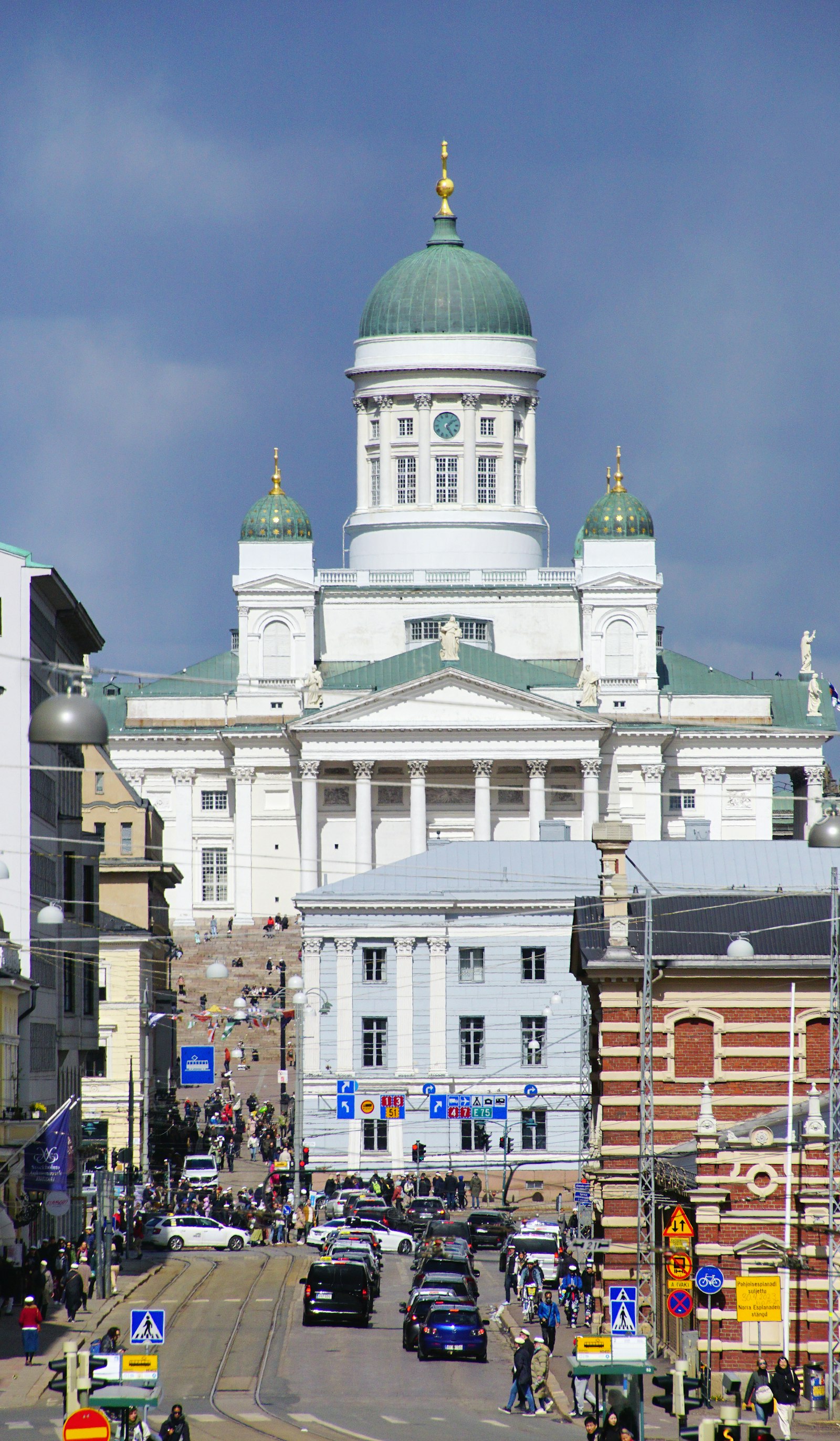
He hired a canvas-maker. Carl Ludvig Engel, a jobless German architect displaced by Napoleon’s 1806 victory, had drifted through Tallinn and St. Petersburg absorbing neoclassical style. In 1816, he was appointed architect of the Helsinki rebuilding committee. By 1824, he was responsible for every key state building in the entire country. He designed Senate Square, the Helsinki Cathedral, the Government Palace, the University, the National Library — the entire face of a capital city, drawn by one man.
Engel loved Helsinki enough to buy two lots on Bulevardi, build his house, and plant a garden. The wine trail passes through the same boulevard the city’s architect chose for his private life.
When the Great Fire of Turku destroyed three-quarters of that city in 1827 — including Finland’s only university — Emperor Nicholas I transferred the entire institution to Helsinki. Overnight, the capital gained an intellectual class: Johan Vilhelm Snellman (philosopher, father of Finnish nationalism), Johan Ludvig Runeberg (national poet), Elias Lonnrot (compiler of the Kalevala). The kind of educated, cosmopolitan people who would eventually create demand for French wine, proper restaurants, and salon culture.
How Did Russian Officers Bring Champagne to Helsinki?
The Russian garrison stationed in Helsinki brought St. Petersburg’s drinking habits north. Russian aristocratic culture was intensely Francophile — French was the language of every drawing room, and French champagne was the drink of choice. Tsar Alexander I himself declared he would only drink Madame Clicquot’s 1811 vintage.
Aurora Karamzin — born in 1808 to a Finnish family in St. Petersburg — became the key cultural mediator between the Russian court and Helsinki society. She moved in European high-society salons and imported that cosmopolitan sensibility to the Grand Duchy’s capital.
Meanwhile, Johan Sederholm’s legacy of inns and taverns evolved into more formal establishments. The military bands performing at Kappeli restaurant on the Esplanade were a direct cultural export from the Russian garrison — officers bringing their social rituals to Finland.
By the 1890s, Helsinki had a recognizable cafe and restaurant culture. Not quite Parisian, not quite Russian, but something distinctly Finnish. Formal enough for the bourgeoisie, relaxed enough for artists. Sibelius drank at Kappeli with painters. Eino Leino wrote poetry there. The same Esplanade promenade where 19th-century bourgeoisie strolled past Russian military bands is now lined with wine terraces every summer.
Helsinki’s wine culture didn’t start with natural wine in 2015. It started with Russian officers drinking French champagne at garrison dinners.
What Happened When Finland Banned All Alcohol?
Finland declared independence in 1917. Two years later, in 1919, it banned all alcohol. The prohibition lasted until 1932, but the instinct to control survived it. In 1932, the government created Alko — a state monopoly that would become one of the most powerful forces in Finnish wine culture, for reasons nobody intended.
The viinakortti (alcohol ration booklet) was introduced in 1943 and lasted until 1971. Every Finnish citizen had a physical booklet that tracked their alcohol purchases. Buy too much, and the shopkeeper refused to sell. The state literally counted your drinks.
Restaurants could serve wine, but until 1969, only if the customer also ordered food. You could not walk into a bar and simply order a glass of wine. The idea that wine was something you drank for pleasure — rather than as an accompaniment to a meal — didn’t exist in Finnish law until the late 20th century.
Even after restrictions eased, the Alko monopoly remained. To this day, all alcohol above 5.5% ABV is sold exclusively through Alko’s roughly 360 stores. You cannot buy a bottle of Barolo at the supermarket. Wine buying in Finland is deliberate, planned, intentional.
This should have killed wine culture. Instead, it accidentally created one of the most interesting wine scenes on earth.
How Did the Monopoly Accidentally Create a Wine Culture?
Here’s what the restrictions did: they pushed wine INTO restaurants and bars. If you couldn’t casually buy wine at a shop, you drank it where sommeliers poured it. The HoReCa (hotel, restaurant, cafe) channel — which buys directly from importers, bypassing Alko entirely — became the laboratory for Finland’s wine revolution.
While Alko sold reliable mainstream selections, Helsinki’s restaurants started importing bottles you couldn’t find anywhere else in Finland. A sommelier at Kuurna (2005, the city’s first serious wine restaurant) could pour a grower Champagne that existed in exactly one location in the country: their wine list.
The scarcity created curation. The curation created expertise. The expertise created a culture where wine wasn’t background music — it was the main event.
Why Does Finland Produce More Masters of Wine Per Capita Than France?
Finland now has five Masters of Wine in a population of 5.6 million. France has 21 in 67 million. Per capita, Finland produces MWs at nearly three times France’s rate.
Essi Avellan became Finland’s first Master of Wine in 2006 — and chose to specialise in champagne, co-authoring Christie’s World Encyclopedia of Champagne & Sparkling Wine. A woman from a country with zero vineyards became the world’s leading champagne authority. She founded Grand Champagne Helsinki, a festival that now attracts 80+ champagne houses and has become a pilgrimage for champagne producers from Reims and Epernay.
Heidi Makinen, Dmitrii Frolov, Antero Niemiaho, and Toni Aikasalo followed. The WSET (Wine & Spirit Education Trust) pipeline runs through Finland with an intensity that suggests the entire country studies for wine exams the way it studies for everything else — methodically, obsessively, as if the apocalypse depends on understanding malolactic fermentation.
How Did Helsinki Go From One Wine Venue to Thirty-Four?
In 2005, Helsinki had exactly one restaurant that took wine seriously. Kuurna, opened by Leena Kronstrom on Meritullinkatu, was primarily a spirit-focused establishment that happened to respect wine. It was a start.
Then, year by year:
2012: Vin-Vin opens on Kalevankatu — Helsinki’s first dedicated wine bar. A standalone wine bar, not a restaurant that happens to serve wine. There’s a hair salon in the back. It proves the model.
2015: BasBas opens in Eira. Parisian bistro meets San Francisco casual meets Italian osteria, with natural wine at the centre. Finland discovers orange wine.
2016: Flor opens in Ullanlinna — the Catalan sommelier David Alberti arrives with an all-natural, small-producer philosophy. The natural wine wave hits Helsinki with full force.
2017: Wino opens in Kallio. Six tables, candlelight, funk soundtrack, natural wine. Bohemian Kallio now has a wine identity.
2019: Muru Wine Bar launches as a standalone space. Samuil Angelov’s nearly 800-wine list becomes the deepest in Helsinki. Wine Spectator Best of Award of Excellence, eight years running.
2023: Minne Champagne & Wine opens on the Esplanade, with Essi Avellan MW curating the champagne list. The story comes full circle — from prohibition to a Master of Wine pouring champagne on the same boulevard where Russian officers drank it 200 years ago.
By 2026, Star Wine List counts 34 great wine bars and wine restaurants in Helsinki. A city of 650,000 people with zero vineyards has more dedicated wine venues per capita than most wine-producing capitals.
Why Is Helsinki the City That Keeps Reinventing Itself?
Helsinki’s wine story is not a story about wine. It’s a story about a city that keeps dying and reinventing itself.
Burned by Ivan the Terrible. Burned by its own defenders. Decimated by plague. Rebuilt by a German architect who was running from Napoleon. Given a university because another city’s caught fire. Occupied by Russia for a century, then independent, then prohibitionist, then monopolised, then — somehow — home to five Masters of Wine and a champagne festival that makes Reims jealous.
The city that Gustav Vasa force-built as a failed trade rival in 1550 now has a sommelier on a military island, a pharmacy turned wine bar, and a woman who wrote the champagne encyclopedia pouring glasses on the Esplanade.
Every sip of wine in Helsinki carries this underdog energy. A city that spent 260 years as a frozen afterthought before becoming one of Europe’s most refined capitals. The improbability is the point.
Walk the story yourself: Helsinki’s Wine Trail — 7 stops, one extraordinary day
Or start where it gets strange: Wine on a fortress island that was locked for 200 years
Frequently Asked Questions
Does Helsinki have a wine scene? Helsinki has 34 dedicated wine bars and wine restaurants as of 2026, five Masters of Wine per 5.6 million people (more per capita than France), and a sommelier culture shaped by the Alko state monopoly, which pushed wine expertise into bars rather than retail. The city went from banning all alcohol in 1919 to hosting Europe’s largest Nordic champagne festival.
Why is Helsinki’s wine scene so good despite having no vineyards? Three factors: the Alko monopoly forced wine into bars where sommeliers curate and educate; the HoReCa import channel lets restaurants carry exclusive bottles; and Finnish educational culture produces wine professionals who study systematically. The absence of local wine production means Finnish sommeliers approach every region without bias.
Who is Essi Avellan MW? Essi Avellan became Finland’s first Master of Wine in 2006, specialising in champagne. She co-authored Christie’s World Encyclopedia of Champagne & Sparkling Wine and founded Grand Champagne Helsinki, the largest champagne festival in the Nordic countries. She curates the wine list at Minne Champagne & Wine on Helsinki’s Esplanade.
When was alcohol prohibition in Finland? Finland enforced alcohol prohibition from 1919 to 1932. After prohibition ended, the government created Alko, a state monopoly that controls all retail alcohol sales above 5.5% ABV to this day. The viinakortti (alcohol ration booklet) tracked individual purchases from 1943 until 1971.
How many wine bars are there in Helsinki? Star Wine List’s 2026 guide counts 34 great wine bars and wine restaurants in Helsinki, with 6 specifically natural-wine-focused. The number has grown from essentially 1 serious wine venue in 2005 to 34 in 2026 — a revolution compressed into less than two decades.
Sources
- Wikipedia: Helsinki — Historical facts and demographics
- Wikipedia: Alko — State monopoly history
- Institute of Masters of Wine — MW directory and member profiles
- Star Wine List Helsinki — Wine bar listings and ratings
- Helsinki City Museum — City archives and historical records
Updated March 2026.